Biography
Born into a lineage of artists, Halton initially turned to art-making as a refuge and a way to navigate the emotional complexities of family life. Her early development was deeply influenced by the raw materiality of Jean Dubuffet, the intuitive layering of Jackson Pollock, and the existential inquiry of Philip Guston. These influences manifest in her central use of the figure—ranging from graphic, cartoon-like forms to gestural silhouettes—and a sophisticated vocabulary of mark-making that explores the psychological space between forms.
A profound turning point occurred in 2013, when Halton became a primary caregiver for her mother following a life-altering accident. This period of limited time but heightened emotion precipitated her move into ceramics. The tactile physicality of clay provided a new medium to process personal grief while examining broader social issues through a three-dimensional lens.
Today, Halton is in a creative "sweet spot," drawing on a deepened understanding of the arc of life to fuel a prolific period of output. Her current practice includes an upcoming installation of drawings and ceramic vessels, a forthcoming book, and a showcase of her prints and pulp paper paintings at the Brooklyn Fine Art Print Fair.
Halton has exhibited extensively at prestigious venues, including the Baltimore Museum of Art, the Orange County Museum of Art, OK Harris Works of Art, and Gallery K. Her work is held in the permanent collections of the U.S. State Department, Kenyon College, and numerous private collections.
Artist Statement
Making art has kept me alive. I’m driven to make sense of the vagaries and challenges of being a human. I visually describe large social and behavioral issues that resonate for me on a personal level. I’m looking for ways to access the dark side of inner life but also show the humor in it.
The role of figures is central, ranging from almost cartoon-like, graphic images to more gestural forms.They symbolize anyone anywhere, and appear outside of specific times and places. Even though they exist in their own worlds they’re designed to address the same ethical, moral, and psychological issues that come up for us. It’s the pictorial space between the figures and forms that has continually evolved.
While the areas the figures move in and around are continually shifting, the vocabulary of images in my work remains consistent: the figure of course, shapes that represent hurdles, escape routes, or shelter, and visual patterns that can mimic behavior ones. It's the psychological engagement of the characters with one another and also with their environments that drives the work.
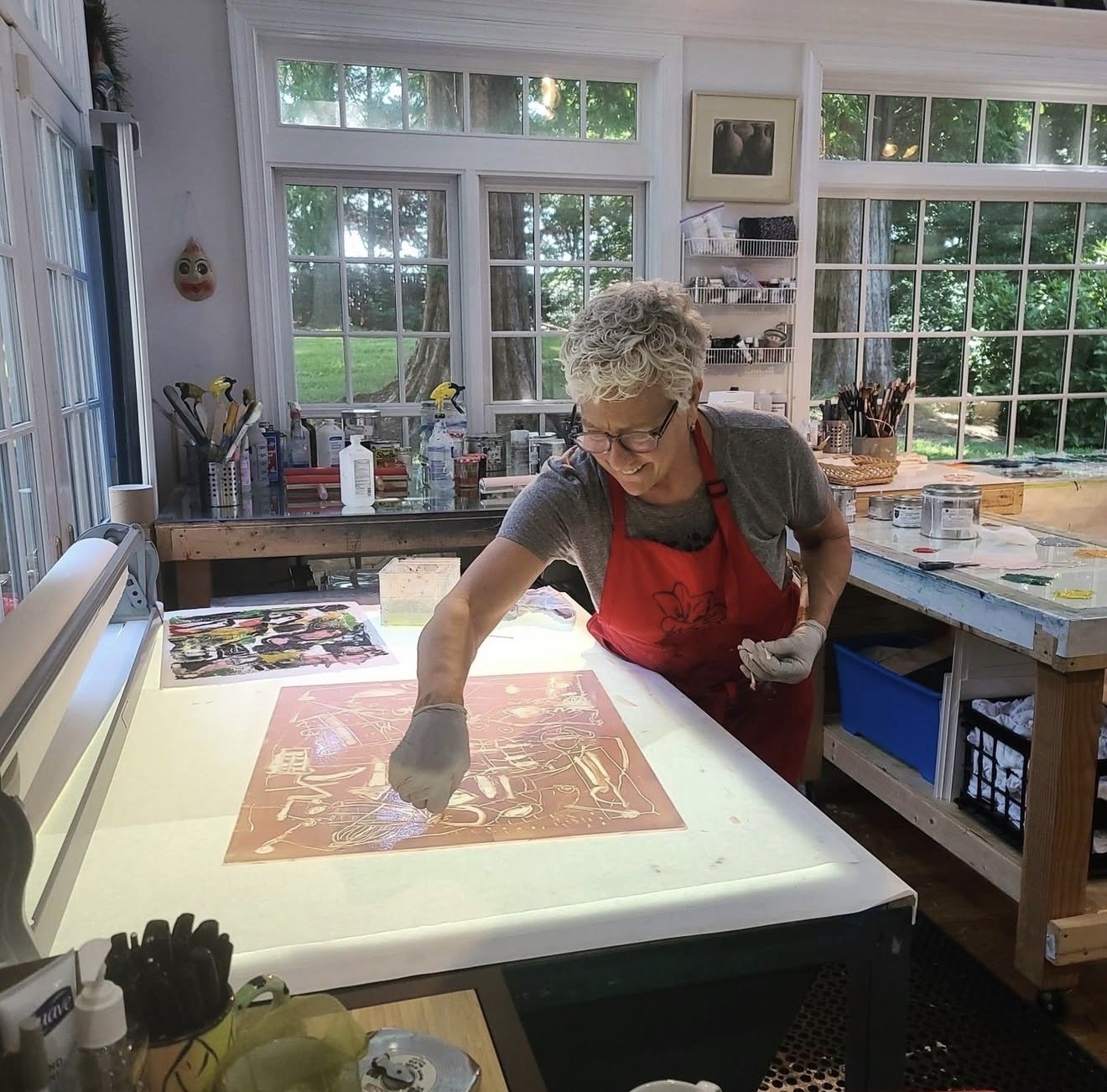
These environments are made up of layers of materials; a sheet of 40”x 30” watercolor paper can include oil and acrylic paints, charcoal, and pastel. I scratch or draw through the top layer eager to see what’s underneath. I work intuitively and with urgency.
Using the same concepts with ceramics as I do in my drawings and prints I can look at a problem from a different point of view, three dimensions vs two. I can literally and physically connect two figures with clay, whereas in my drawings it’s the idea of connecting that I’m looking for.
The ideas that I consider are ongoing and universal, and seemingly never change. I don’t include horizon lines or specific light sources. Time has collapsed in the worlds I’m creating. The figures continually move, seemingly without purpose. I’ll repeat a figure or shape over and over. Change happens slowly, one of us at a time.
While I think about the world at large and how profoundly difficult it is to begin to navigate, I wonder how I can remain an active participant in it. Making art is just the beginning for me. How can I show the role of curiosity and the importance of looking beyond the surface and into the meaning and implications of an event or encounter.